Excel TV ExcelTV

Dynamic References for Excel Form Controls

Updated

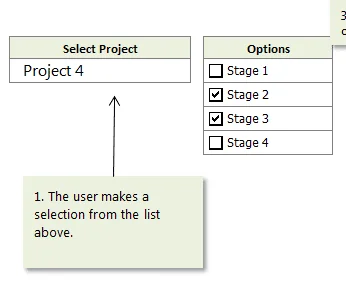
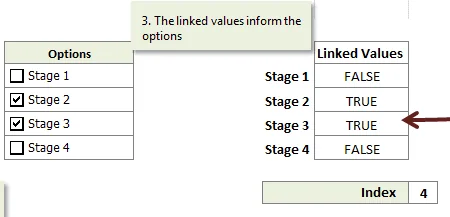
Form controls are great for reporting information about groups of items, like a list of programs or accounts. They are often used on Excel dashboards and reports that demand interactive capabilities. One such type of capability provides the user with a list of items to choose from. When the user makes a selection, a macro is executed that populates a table holding referenced values. Those values are linked to a series of form controls on the frontend. This interactivity is displayed below:

!
Step 1
!
Step 2
!
Step 3

There is a final step, which I haven’t included. The user would make changes to the project under the Options table. They would press a “Save” button and their changes would be copied from the Linked Values table back onto the backend data in the column corresponding to the selected project using VBA.

The No-VBA way

There’s nothing wrong with this method in and of itself, but I want to propose a method that requires no VBA. The advantage of this new method is that it links directly to the data itself and bypasses the need for the Linked Values table. We can do this by allowing the form controls to take advantage of dynamic references.

Typically, form controls can only do direct, absolute references. You cannot, for example, use VLOOKUP or INDEX within the source field of a form control. However, you can use a named ranges.

Let’s do it!

First, we give that ‘index’ field above a named. How about selection? Next, we create four named ranges to correspond to the form control checkboxes. Stage_1 to Stage_4 are those new named ranges.

!

As you can see from the picture, I use the fourth row to connect to checkbox Stage 4 and the selection value to inform Excel to pull from the fourth column in the backend data (which is Project 4, if you recall).

Finally, I can simply link these named ranges to their associated checkboxes:

!

Using this method, changes to the checkbox automatically change the backend data. There is no intermediate table required — like the Linked Values table above — to interface between the frontend and the backend.

That’s all for now – have a happy and health holiday season!

Update 25 December:
Make sure to see the download file – Direct Links.xlsm.

Written by

Jordan Goldmeier
Jordan GoldmeierCo-founder, Excel TVFormer Adjunct Instructor, Wake Forest University

Consultant, Anarchy Data · Instructor, Full Stack Modeller

  • Excel
  • Financial Modeling
  • Data Visualization
  • Analytics
Jordan Goldmeier is an accomplished data professional with a wealth of experience across various industries. He currently serves as a consultant at Anarchy Data, where he assists businesses in maximizing the capabilities of Excel for financial planning and analysis. Jordan is also an instructor at Full Stack Modeller and a former Adjunct Instructor in Analytics at Wake Forest University. His extensive career has seen him hold positions as the Chief Operations Officer at Excel.TV, Data Science Manager at DataKind, Data Scientist at Dealer Tire and EY, Analytics & Data Vis Developer at The Perduco Group, and Operations Research Analyst at Booz Allen Hamilton. Jordan's background in data analytics and his passion for Excel make him a valuable resource for businesses seeking to improve their data-driven decision-making processes.

Read more articles by Jordan Goldmeier

Editorial standards

Fact Checking & Editorial Guidelines

Every article on Excel TV is held to a published editorial standard. The goal: accurate, current, and useful — without filler.

  1. Expert review. Drafts on technical Excel topics are reviewed by a contributor with hands-on, working knowledge of the feature being covered.
  2. Source validation. Claims about Excel behavior are tested in current Microsoft 365 builds. Third-party product claims are sourced from the vendor's own documentation.
  3. Disclosure. Affiliate links, sponsorships, and any commercial relationships that influenced a piece are disclosed in-line and at the foot of the article.
  4. Updates. Articles are revisited when Microsoft ships changes that affect the content. The most recent revision date is shown on every post.

Spot a problem? Email editor@excel.tv and we will look at it.

Subject-matter review

Reviewed by Subject Matter Experts

Technical Excel articles are reviewed by contributors with verifiable, hands-on experience in the topic — not generalist editors.

  • Qualified reviewers. Reviewers include Microsoft Excel MVPs, working business-intelligence practitioners, and Excel TV editorial staff. See each author's page for credentials.
  • Current to a known Excel build. Procedural articles state which Excel version they were validated against. Where Microsoft has since changed behavior, the article carries an inline update note.
  • Clarity check. Reviewers verify steps are reproducible by a reader at the assumed skill level — not just technically correct in a vacuum.

Want to contribute or review for Excel TV? See the about page.